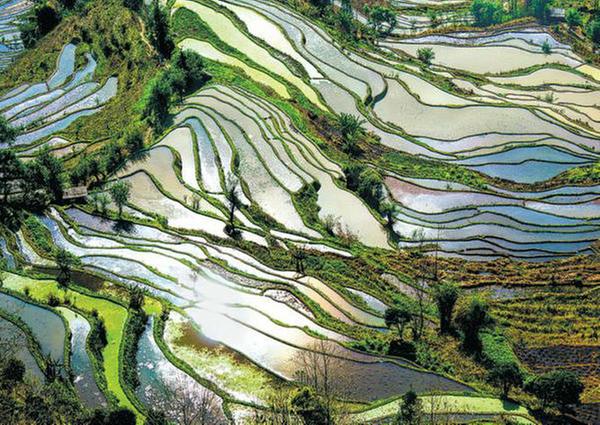
Cultural Landscape of Honghe Hani Rice Terraces
Introduction
The Cultural Landscape of Honghe Hani Rice Terraces is a remarkable example of a human-modified natural landscape, stretching across 16,603 hectares in Yunnan province, China. Nestled within the Ailao Mountains, these terraces cascade down the slopes to the banks of the Honghe River, showcasing an awe-inspiring system of rice cultivation that has evolved over more than 1,300 years. This site was officially inscribed on the UNESCO World Heritage List on June 22, 2013, and it stands as a testament to the ingenuity and sustainable agricultural practices of the Hani people. The terraces' harmonious integration with the environment represents a unique cultural legacy that combines agriculture, forestry, and water management systems, underscored by socio-economic and religious traditions.
History and Background
The history of the Honghe Hani Rice Terraces dates back over 1,300 years, originating from the agricultural and cultural practices developed by the Hani ethnic group. The Hani people migrated to this region and transformed the challenging topography of the Ailao Mountains into fertile rice terraces through an intricate system of channels and ditches that transport water from the mountaintops to the lower terraces. This water management system is not only a testament to their engineering prowess but also a reflection of their deep spiritual connection to the natural elements such as the sun, moon, rivers, and forests, which they revere and worship.
The terraces have evolved into an integrated farming system that includes the cultivation of red rice as the primary crop, supported by the symbiotic rearing of livestock such as buffaloes, cattle, ducks, fish, and eels. These animals play critical roles in fertilizing the fields and controlling pests, thus maintaining the ecological balance of the terraces. The villages in the region are characterized by traditional thatched "mushroom" houses, where the Hani community has lived in ecological harmony with their surroundings, guided by longstanding social and religious structures that emphasize unity between humans and nature.
Geography and Environment
The Honghe Hani Rice Terraces are located in Yuanyang County within the Honghe Hani and Yi Autonomous Prefecture in Yunnan province. This region is marked by its rugged mountainous terrain, with the terraces sculpted into the slopes of the Ailao Mountains, descending dramatically towards the banks of the Honghe River. The terraces are situated at altitudes ranging between 600 to 2,000 meters above sea level, which provides diverse microclimates conducive to rice cultivation.
The environmental conditions of the region, including its ample rainfall and the fertile volcanic soil, are ideal for agriculture. However, the steep slopes and absence of flatland present challenges that require innovative agricultural practices. The terraces themselves not only conserve water but also enhance soil fertility and prevent erosion. This unique landscape is a living example of human adaptation to the natural environment, demonstrating how traditional agricultural practices can foster biodiversity and sustain ecological systems.
Cultural Significance
Ethnic Groups
The Hani people, the primary ethnic group of this region, have developed a unique cultural identity built around their agricultural practices and spiritual beliefs. Their society is structured around the Man-God Unity social system, which emphasizes the interconnectedness of humans, nature, and the divine. This system reinforces a dual inter-dependence, where the physical environment, socio-economic activities, and religious ceremonies are closely intertwined, creating a harmonious balance that has sustained the community for centuries.
Agricultural Practices
The agricultural practices of the Hani people are characterized by a sophisticated terrace farming system that integrates water management, soil conservation, and biodiversity. Rice is the principal crop, grown alongside fish and ducks, which contribute to pest control and fertilization. Water buffaloes are employed to plough the fields, while chickens and pigs provide additional manure. This system not only ensures sustainable food production but also enhances the resilience of the local ecosystem, as each component of the farming system supports the others, creating a self-sustaining agricultural model.
Festivals and Traditions
The cultural calendar of the Hani people is rich with festivals and traditions that reflect their agricultural lifestyle and spiritual beliefs. These traditions include rituals and ceremonies that mark the beginning of the planting season, the harvest, and other significant agricultural activities. The festivals are often accompanied by the singing of Hani-haba, polyphonic choral music that serves as both a cultural expression and a means of passing down agricultural knowledge through generations. The festivals not only reinforce community bonds but also celebrate the intimate relationship between the Hani people and their environment.
Conservation Efforts
In recent years, several conservation efforts have been initiated to preserve the Honghe Hani Rice Terraces and their cultural heritage. These efforts include government and community-led programs aimed at maintaining traditional agricultural practices and protecting the natural environment from modern threats such as deforestation and urbanization. The local government, in collaboration with educational institutions and NGOs, has implemented measures to enhance the understanding of the importance of cultural heritage among the younger generations. Moreover, sustainable tourism initiatives have been developed to balance economic growth with cultural preservation, ensuring that the terraces remain a source of both cultural pride and economic stability for local communities.
Tourism and Economic Impact
The Honghe Hani Rice Terraces have become a major tourist attraction, drawing visitors from around the world who are eager to experience the scenic beauty and cultural richness of the landscape. This influx of tourism has had significant economic benefits for the region, providing new sources of income for local residents. Traditional products such as red rice, paddy fish, and duck eggs have gained popularity, and their sale contributes to the economic prosperity of the local communities. Tourism has also spurred the development of supportive infrastructure, including accommodations and transportation facilities, which further enhances the economic landscape.
However, the growth in tourism also presents challenges, such as the potential for overdevelopment and the strain on local resources. To address these issues, sustainable tourism practices have been implemented, emphasizing eco-friendly initiatives and the preservation of cultural authenticity. The involvement of the local community in tourism planning ensures that development aligns with cultural values and environmental sustainability.








